The Cloud With a Sun Compass: What If AI Data Centers Roamed the Map?
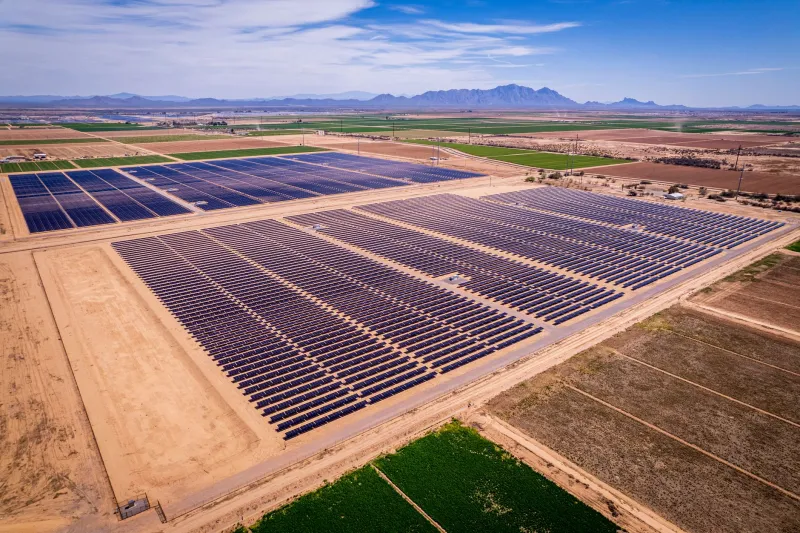
Most data centers are designed like basements: heavy, fixed, and hungry around the clock. Solar power is the opposite. It shows up on a schedule, varies with weather, and often produces more electricity than a region can use at noon. So here is a thought experiment: what if AI data centers stopped pretending the grid is a flat line and instead chased the sun across the United States?
The Pitch: Compute as a Moving Crop
Picture a fleet of modular AI facilities—shipping-container cousins packed with servers, cooling, and network gear—parked next to solar farms in Arizona, Nevada, New Mexico, and West Texas. When the desert heats up and solar output climbs, they train models. When the monsoon rolls in or the evening peak arrives, they power down or move on. In summer, the fleet could drift toward the Midwest and Southeast, following daylight and surplus generation. The idea is not that every server becomes a nomad. It is that some workloads—especially batch training and offline inference—can be scheduled like a harvest.
Follow-the-sun computing is already a familiar idea in global cloud operations, where workloads shift between time zones to catch cheap power and spare capacity. Chasing solar is different. It is not about avoiding night; it is about leaning into the middle of the day, when solar panels are producing at full tilt and grid operators sometimes curtail clean power because there is nowhere for it to go.
Latency Is the Grown-Up in the Room
Not every AI job can pack a suitcase. Training a large model can run for days and tolerate pauses; a chatbot answering a customer in Chicago cannot wait for a server to finish a road trip from Nevada. That splits the fleet into two classes. The wandering giants handle training, fine-tuning, video rendering, and other delay-tolerant work. Small, always-on edge facilities handle real-time inference near users. The wandering fleet could also carry cached models and dispatch results over fiber, but physics still sends a bill. A cross-country fiber route adds tens of milliseconds, and some applications feel that.
The practical version may be less romantic than a convoy of trucks. A company could lease capacity at several solar farms and move software, not hardware, between them. Containers would migrate seasonally, not daily. The interesting question is whether that flexibility is worth the engineering overhead.
Land, Water, and the Neighbors
Data centers need land, cooling, and a social license. A modular solar-chasing site could use brownfields, retired industrial parks, or disturbed land near existing solar farms, which is easier than breaking ground in a suburb. Water is trickier. Some cooling systems drink a lot; air-cooled designs use less water but more electricity, which can erase the solar advantage. Dust and heat in the Southwest also punish equipment.
Then there is the local bargain. A town may welcome a data center for tax revenue and jobs, then watch it leave when the weather changes. That is a real political risk. Supporters would argue that a movable facility is better than no facility, especially if it pays rent and uses power that would otherwise be curtailed. Critics would ask who pays for the roads, substations, and fire service that a temporary occupant relies on.
The Grid Politics of a Moving Load
Grid operators love predictable demand and are suspicious of anything that looks like a loophole. A solar-chasing data center is a flexible load, which sounds useful: it can soak up midday surplus and ease curtailment. But if the load can move between states, it can also dodge demand charges, capacity obligations, and local reliability rules. That is where policy gets interesting.
ERCOT, California's CAISO, and PJM all treat large loads differently, and a national fleet would have to navigate a patchwork. One model is a special flexible-load tariff: cheaper power in exchange for agreeing to pause or shift within minutes. Another is a capacity contract that pays the data center to be available when the grid is stressed. The worst outcome is a game of regulatory arbitrage, where compute chases subsidies and leaves utilities holding the bill for infrastructure.
What Would Make It Real
The technical ingredients are not exotic: rugged modular buildings, high-bandwidth fiber, scheduling software, and cooling that can handle dust and heat. The business model is harder. Solar farms would need to offer firm contracts, not just midday leftovers. Customers would need to accept slower turnaround for some jobs. And grid operators would need confidence that a movable load will not vanish during a heat wave.
A realistic first draft is modest: a few dozen containers rotating among a handful of solar-rich sites, handling batch AI work and maybe industrial data processing. If that works, the idea could grow into a network of solar-following compute corridors. It would not make intermittency disappear. It would turn a limitation into a scheduling signal—and that is a very solar kind of idea.