Old Coal, New Heat: The Smokestack-Swap Thought Experiment
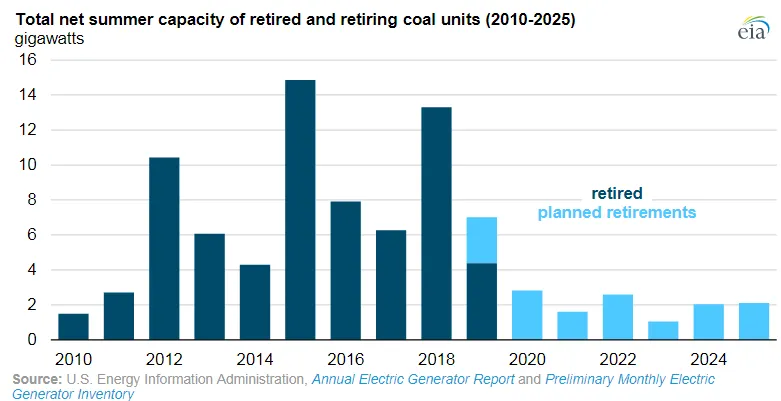
Photo: U.S. Energy Information Administration, Public domain, via Wikimedia Commons
America has a lot of coal plants that are running out of road. Some are closing because they are old, some because gas and renewables are cheaper, and some because their owners would rather not spend another dollar on a 1970s boiler. The usual story ends with a demolition crew. But what if the site stayed in the electricity business?
The Reuse Case: Steel, Copper, and Interconnection
A coal plant is more than a smokestack. It has a high-voltage switchyard, transmission rights, water rights, rail access, cooling towers, a steam turbine, a generator, and a workforce that knows how to run a power plant. Those assets took decades and a lot of permitting to assemble. The most valuable part may be the grid connection. New generators often wait years in interconnection queues, while a retiring coal plant already has a seat at the table.
A solar thermal retrofit would try to keep as much of that skeleton as possible. Concentrated solar power uses mirrors to focus sunlight onto a receiver, heating a working fluid. That heat can drive a steam turbine or be stored in molten salt or hot sand. If the steam conditions match, an existing coal turbine could be repurposed. Even if the turbine needs a new rotor or a different design, the generator, transformer, and switchyard might survive.
How the Heat Works
The basic idea is simple. A field of heliostats—computer-controlled mirrors—follows the sun and bounces light onto a central receiver. The receiver heats nitrate salts or a stream of sand. Hot salt can be stored in insulated tanks and used later to make steam. Hot sand can be held in silos and moved through heat exchangers. The plant becomes a thermal battery, not a chemical one.
That is the elegant part. The awkward part is geography. Concentrated solar works best in places with strong direct sunlight, like the desert Southwest. Many retiring coal plants sit in the Midwest, Appalachia, and the Southeast, where humidity and haze reduce direct normal irradiance. A solar thermal retrofit in Ohio is not the same proposition as one in Nevada. Some sites could use solar heat for industrial processes or pair it with other heat sources, but the pure solar case is strongest in the dry West.
The Economics of a Second Life
Solar thermal has struggled in the United States. Ivanpah and Crescent Dunes became cautionary tales as much as technical milestones, and cheap solar panels plus lithium batteries have won most new-build contests. But a retrofit is a different calculation. It avoids some land costs, uses existing transmission, and may qualify for brownfield or energy-community incentives. It also offers long-duration storage, which matters more as grids fill up with midday solar and look for ways to keep the evening lights on.
The catch is efficiency. Thermal storage loses energy at every conversion step: sunlight to heat, heat to steam, steam to electricity. Round-trip efficiency is lower than a lithium battery. The bet is that low-cost heat storage and reused equipment can beat a battery on cost per kilowatt-hour of long-duration capacity. That bet gets better if the plant can sell heat directly to a factory, a district heating system, or an industrial park.
The Community Question
Coal communities have heard a lot of transition promises. A solar thermal hub would not bring back the same number of jobs; mines and boiler houses are labor-intensive in ways that mirror fields are not. But it could keep some skilled operators, electricians, and maintenance crews, and it could preserve the tax base that funds schools and services. That matters in places where the plant is the largest taxpayer.
The environmental story is mixed. Reusing a site avoids new disturbance, but coal ash ponds and contaminated groundwater still need cleanup. A developer would have to decide who pays for remediation and how to protect the surrounding community. The best projects would treat cleanup as part of the deal, not a footnote.
Where It Might Work First
The most plausible first project is a retiring coal unit in the desert Southwest with strong sun, existing transmission, and a buyer for long-duration capacity. A second model could be a smaller industrial plant that uses solar heat directly, with a turbine as backup. The worst model is a forced retrofit in a cloudy place with no customer and no storage market.
A coal plant that becomes a solar battery is not a silver bullet. It is a way to squeeze more value out of infrastructure that already exists. In a country trying to retire coal without abandoning the people who built it, that is worth a serious look.