Power Beamed From Orbit: Can America Make Space Solar Add Up?
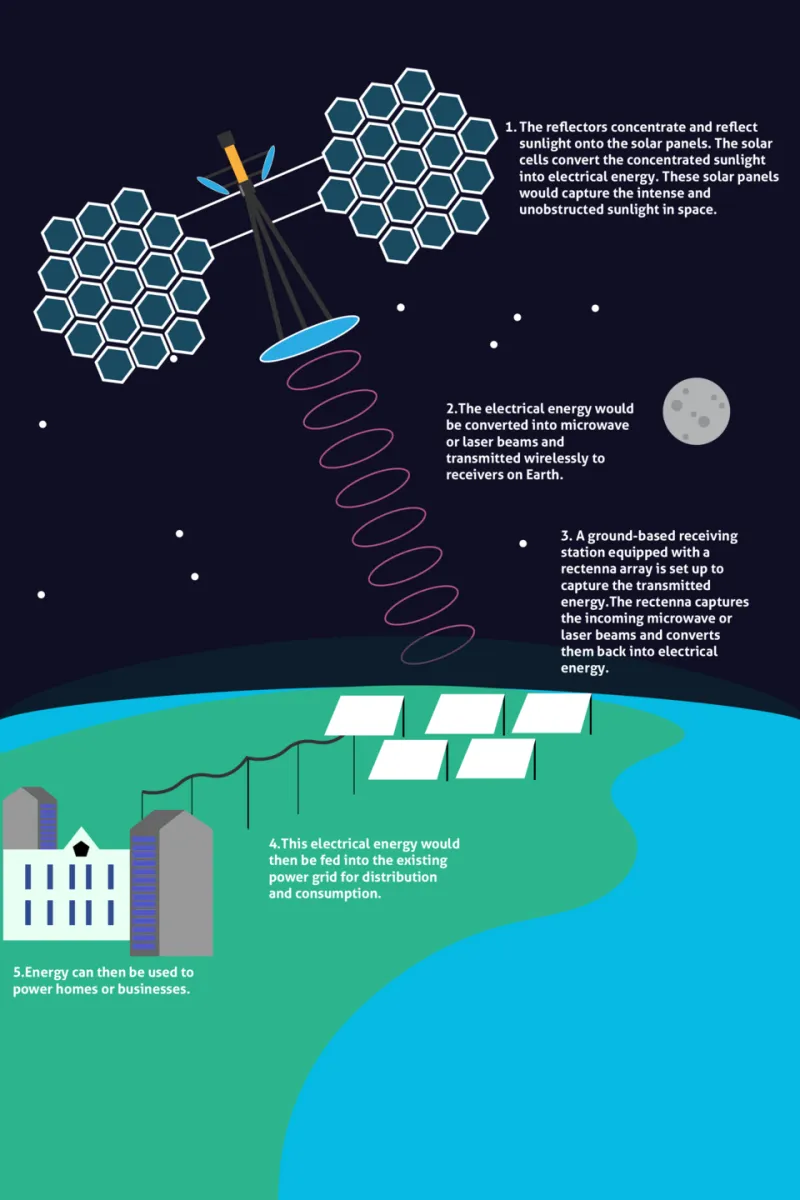
Photo: Tylerhung445, CC0, via Wikimedia Commons
Space-based solar power has a reputation problem. It sounds like a 1970s engineering dream that never escaped the whiteboard. As of 2026, however, the idea is getting a serious second look. Launch costs have fallen. Wireless power experiments have moved from lab demos to modest outdoor tests. And the US military keeps funding studies because fuel convoys and remote bases are expensive.
This is not a prediction that a giant orbital power plant will light up American homes by 2030. It is a thought experiment: what would it actually take for the United States to build a solar station in space, and could the economics close by the 2030s?
The basic physics is not the problem
A solar panel in geostationary orbit sees sunlight almost continuously. No night, no clouds, no weather. The catch is getting the power down. The leading concept uses microwaves: convert electricity to a microwave beam, send it to a large ground antenna called a rectenna, and convert it back to electricity.
The physics works in the lab. The scale is the monster. A commercially relevant plant might need to deliver one gigawatt to the grid. That means a solar array many kilometers across, a transmitter of similar scale, and a receiving site measured in kilometers. The mass budget is brutal. Every kilogram has to be launched, assembled, or manufactured in orbit.
Launch costs are the gatekeeper
Falling launch prices are the reason this conversation is back. If a heavy-lift rocket costs tens of millions of dollars instead of hundreds of millions, the math improves. But space solar needs more than cheap launches. It needs reliability, cadence, and orbital assembly.
A useful comparison is not a rooftop array. It is a nuclear plant or a large hydro project: capital-intensive, slow to permit, and judged over decades. Space solar would have to compete with terrestrial solar plus storage, which is cheap and getting cheaper. That is the real benchmark.
The scenario gets more interesting if launch costs keep dropping and if in-orbit manufacturing matures. A plant built from modules launched on many rockets could be assembled by robots. That is a 2030s story, not a next-year story.
The grid side is a permitting problem
Even a perfect orbital plant needs a place to land its beam. A rectenna site would need land, transmission lines, environmental review, and local consent. In the United States, that means the same interconnection queues and zoning fights that vex terrestrial renewables.
There is also the question of beam safety. Microwave power beaming at low intensity is not a death ray, but public perception matters. Regulators would need clear standards for exposure, airspace, and wildlife. A site in the desert Southwest is the obvious candidate, but transmission to coastal cities is another cost.
Spectrum is the quiet battlefield
Space solar would rely on microwave frequencies. That puts it in the path of telecommunications regulators and international spectrum negotiations. The Federal Communications Commission would handle domestic licensing; the International Telecommunication Union would matter for global coordination.
This is where space solar becomes a space policy story, not just an engineering one. A US plant would need protected frequencies, and other countries would want guarantees that the beam does not interfere with satellites or terrestrial networks. Military interest complicates the picture: the Pentagon has studied space solar for forward operating bases, which could accelerate technology but also raise concerns about dual-use infrastructure.
Could the economics close?
Maybe, in niche markets first. Remote military bases, disaster relief, and island grids pay a premium for reliable power. If a small demonstration plant can deliver power at a painful but tolerable cost, it could justify the next scale.
For the continental US grid, the bar is higher. Terrestrial solar plus batteries is already cheap in sunny states. Space solar would need to offer something those cannot: baseload-like output, small land footprint, or resilience. That is possible, but not guaranteed.
The honest answer as of 2026 is that space solar is a research program with a plausible path, not a bankable project. The 2030s could change that if launch costs fall further and in-orbit assembly proves out. Or it could remain a beautiful idea that never beats a field of panels in Arizona.
What would make it real
A serious US effort would need three things: a funded demonstration that beams meaningful power to a grid, a regulatory framework for spectrum and safety, and a buyer willing to pay early-adopter prices. The military could be that buyer. So could a consortium of utilities.
The thought experiment is worth running because it forces clarity. Space solar is not magic. It is a logistics problem, a permitting problem, and a cost problem. If those close, the microwave sunrise is not science fiction. If they do not, the sun will keep doing its best work down here.